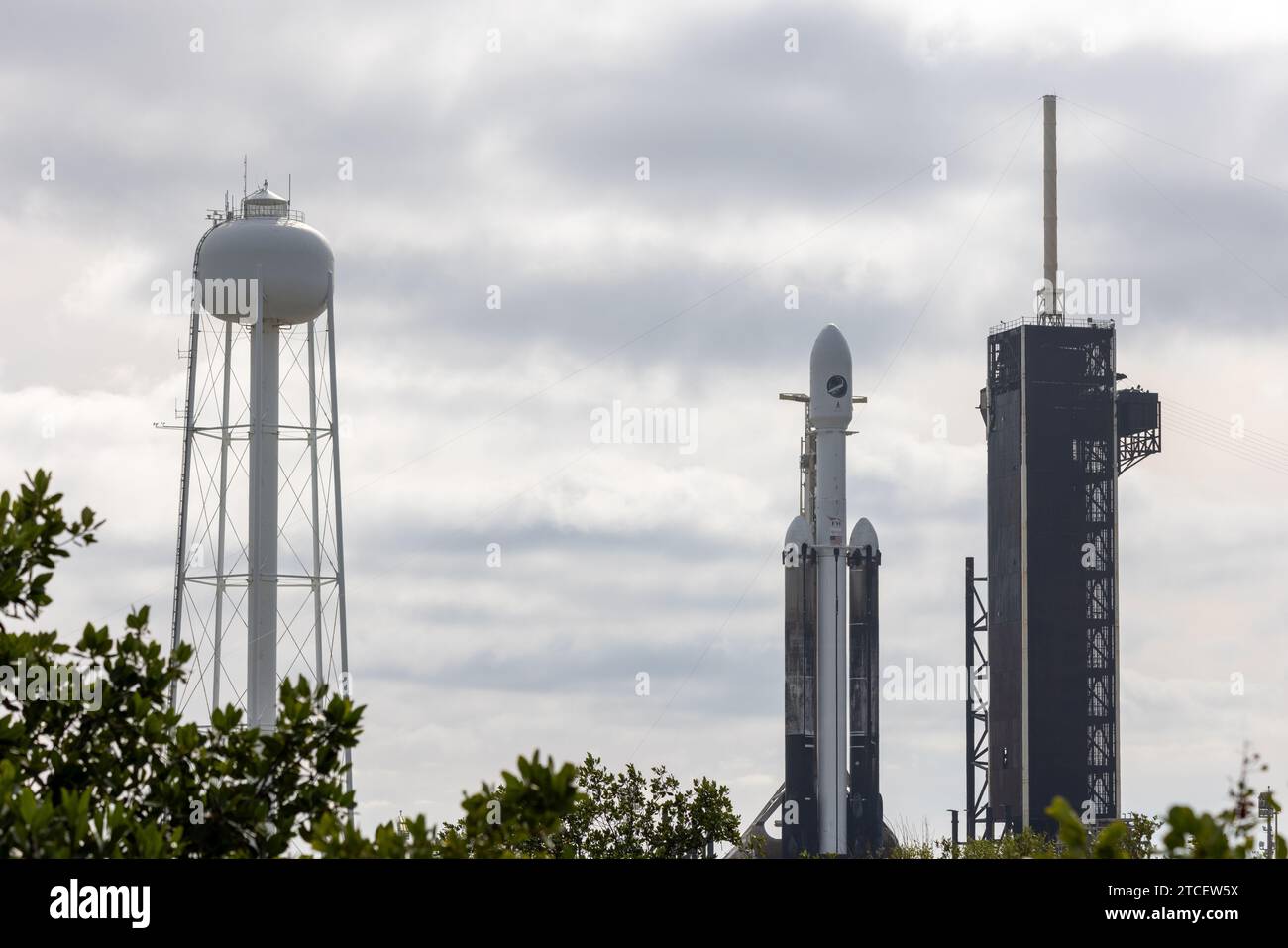
Monday’s planned Falcon Heavy launch ended in a silent retreat—no fiery liftoff, no thunderous roar. Instead, thick clouds and unfavorable wind conditions forced SpaceX to scrub the mission just hours before ignition. Now, the company is resetting for a second attempt, with conditions improving and anticipation building at Launch Complex 39A in Kennedy Space Center.
This isn’t failure. It’s precision.
SpaceX operates on margins where degrees, seconds, and pressure systems make the difference between orbital success and a costly anomaly. The scrub reflects not a flaw in the system but adherence to it. Weather remains one of the most unpredictable variables in launch operations—and Monday’s unstable conditions over Florida’s Space Coast crossed the flight safety threshold.
But the countdown has resumed. Live coverage is gearing up. And the world is watching again.
Why the Falcon Heavy Launch Was Scrubbed on Monday
At 3:18 p.m. ET, SpaceX confirmed the delay. The primary culprit? Persistent cloud cover and unacceptable upper-level winds across the Atlantic launch corridor.
Falcon Heavy relies on a narrow flight path that demands clear atmospheric conditions not only at liftoff but also through ascent and stage separation. Weather rules aren’t arbitrary—they’re based on decades of data about aerodynamic stress, lightning risk, and abort safety.
Key weather constraints include: - Ceiling height: Must be above 6,000 feet - Visibility: Minimum 5 miles - Wind shear: Within strict tolerance thresholds - Lightning risk: Zero tolerance within 10 nautical miles
On Monday, scattered thunderstorms and high moisture content created a lightning risk that violated one or more of these conditions. With the launch window opening at 5:09 p.m. ET, there was no margin for error.
A scrub is never ideal—but for SpaceX, it’s routine. The company has maintained a 98% mission success rate since 2010, in part because it refuses to compromise on safety margins. This discipline is baked into every launch decision.
Next Launch Window: When and Where to Watch
The next attempt is currently scheduled for Wednesday, pending final confirmation from the Eastern Range and updated weather forecasts.
Launch window opens at 4:56 p.m. ET, with live coverage beginning approximately one hour prior on SpaceX’s official website and YouTube channel. The broadcast will include real-time telemetry, commentary from mission control, and camera angles from the pad, drone ships, and tracking aircraft.
If weather delays persist, secondary opportunities exist on Thursday and Friday, though each day introduces new variables—particularly midweek tropical moisture creeping up from the Caribbean.
Viewers can expect: - T-30 minute hold for final systems check - Autonomous flight software activation - Final go/no-go polls from propulsion, guidance, and range safety teams - Liftoff of all 27 Merlin engines across three boosters
Unlike typical Falcon 9 launches, Falcon Heavy’s three-core configuration produces over 5 million pounds of thrust—making it the most powerful operational rocket in the world. The visual alone—three boosters firing in unison—is a spectacle few rocket launches can match.
Understanding the Mission: What’s Flying on This Launch?
While SpaceX has not disclosed full payload details—standard for national security and commercial contracts—this mission is widely believed to carry a USSF-52 satellite for the U.S. Space Force.

USSF missions typically involve advanced communications, surveillance, or orbital monitoring platforms. Based on previous launches of this class, the payload likely weighs over 8,000 kg and is destined for geosynchronous orbit, requiring the Falcon Heavy’s full lift capacity.
What makes this launch strategically significant: - Demonstration of heavy-lift reliability for national defense - Triple-core recovery test—both side boosters expected to land at Cape Canaveral - Core booster attempt on drone ship Just Read the Instructions stationed ~900 miles downrange
Falcon Heavy’s ability to deploy large, high-orbit payloads while recovering all three boosters reduces long-term launch costs and cements its role in both military and deep-space infrastructure.
Past missions have included: - Arabsat-6A (2019) – Communications satellite to GEO - STP-2 (2019) – DoD technology demonstration - Formosat-5 (2017) – Earth observation
Each mission pushed boundaries in reusability, trajectory, and payload deployment. This launch continues that legacy.
Behind the Scenes: The Countdown and Pre-Launch Workflow
While viewers see a two-hour broadcast, the real action begins 72 hours before launch.
Here’s how SpaceX engineers and launch teams prepare for a Falcon Heavy mission:
T-72 Hours: Final Vehicle Checks
- Cryogenic loading simulations
- Guidance system alignment
- Range safety beacon verification
- Autonomous flight termination system (AFTS) test
T-24 Hours: Pad Transition
- Strongback retraction test
- Propellant farm pressure checks
- Weather balloon launches every three hours to sample upper-atmosphere conditions
T-8 Hours: Crew Arrival and Terminal Countdown
- Launch director assumes control
- Fuel farm chill-down begins
- Range clearance from Air Force Eastern Range
T-38 Minutes: Terminal Count
- Transition to internal power
- Merlin engines thermally conditioned
- Flight computers switch to auto-sequence
T-3 Seconds: Engine Ignition Sequence All 27 engines ignite in a staggered pattern to prevent structural overload. Only when all reach full thrust does the hold-down clamp release.
It’s a ballet of engineering and timing. One misstep—like a sensor anomaly or pressure drop—triggers an automatic abort. The system is designed to fail safely.
The Challenge of Landing All Three Boosters
Recovering all three Falcon Heavy boosters remains one of SpaceX’s most complex operations.
The two side boosters, essentially modified Falcon 9 first stages, return to Landing Zones 1 and 2 at Cape Canaveral. Their synchronized touchdown—often within seconds of each other—has become iconic.
But the center core faces a far more punishing trajectory: - Travels faster and farther - Endures higher reentry temperatures - Must land on a drone ship in rough seas
Historically, center core recovery has had a 50/50 success rate. Stresses during reentry often exceed design limits, and minor deviations in throttle control can lead to hard impacts.
For this mission, SpaceX appears confident. Data from recent Falcon 9 ocean landings suggest improved grid fin responsiveness and cold-gas thruster stability—critical for maintaining control during the final descent.
If all three boosters return intact, it will mark only the third time in Falcon Heavy history that full recovery was achieved.
Weather Outlook for the Next Attempt As of Tuesday morning, the forecast shows improvement.
The National Weather Service gives a 70% favorable chance for Wednesday’s launch window, with scattered clouds, light winds, and no thunderstorm risk within 20 miles of the pad.
| Key conditions: | ||
|---|---|---|
| --------- | ------------------ | ------------------ |
| Ceiling Height | 8,000 ft | >6,000 ft ✅ |
| Surface Winds | 10 mph SE | <25 mph ✅ |
| Upper-Level Winds | 45 knots at 30k ft | <60 knots ✅ |
| Lightning Risk | Low | No storms within 10 NM ✅ |
Still, weather remains the biggest variable. Coastal fog could roll in late afternoon, and sea breezes may trigger isolated convection near the coast.
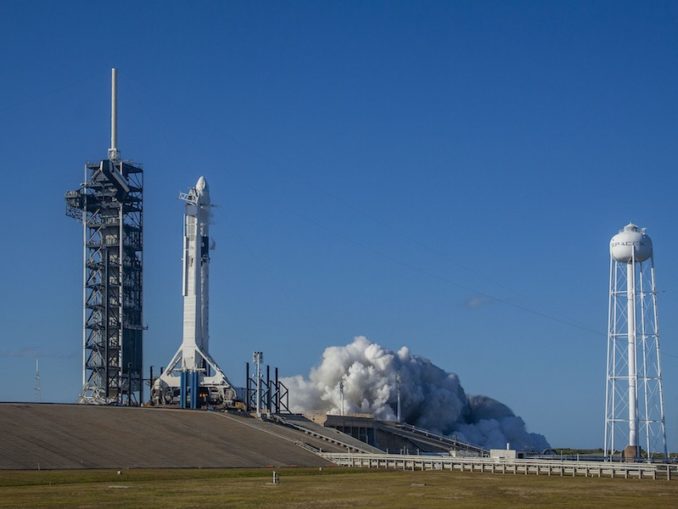
SpaceX will conduct a final weather briefing at T-6 hours. Until then, mission teams are proceeding as if launch is on.
Why Falcon Heavy Still Matters in the SpaceX Fleet
While the Starship program dominates headlines, Falcon Heavy remains critical—not obsolete.
It serves a unique niche: heavy payloads to high-energy orbits—missions too big for Falcon 9, too urgent for Starship (still in development).
Consider: - Falcon 9: Max payload to GTO — ~8,300 kg - Falcon Heavy: Max payload to GTO — ~26,700 kg - Starship (planned): ~200,000 kg to LEO
Until Starship achieves regular, reliable flight, Falcon Heavy is the only U.S.-operated rocket capable of lifting next-gen spy satellites, interplanetary probes, or massive space telescopes.
Moreover, Falcon Heavy’s reusability slashes costs. A full launch costs ~$90 million—less than half the price of legacy heavy-lift vehicles like Delta IV Heavy, which cost over $350 million per flight.
It’s not flashy. It’s functional. And it’s flying when others can’t.
How to Follow the Launch Live For those tracking the second attempt, here’s how to stay updated:
Official Sources: - spacex.com/webcast – Primary live stream with mission control audio - @SpaceX on X (Twitter) – Real-time updates and anomaly alerts - NASA+ – Occasionally rebroadcasts major SpaceX missions - Spaceflight Now – Independent live blog with expert commentary
Recommended Viewing Times: - 3:30 p.m. ET: Pre-launch analysis begins - 4:30 p.m. ET: Final go/no-go polls - 4:56 p.m. ET: Liftoff (if all systems green) - 5:05 p.m. ET: Side booster landings - ~5:20 p.m. ET: Core booster landing attempt
Set reminders. Signal strength matters—especially if watching on mobile near coastal areas.
Final Countdown: What’s at Stake
This isn’t just another launch. It’s a test of resilience.
SpaceX has proven it can build rockets. Now, it must prove it can sustain momentum—through weather, through delays, through public expectation.
The second attempt at Falcon Heavy flight USSF-52 isn’t about spectacle. It’s about consistency. About showing that reusability, reliability, and responsiveness can coexist in modern launch systems.
If all goes well, two boosters will thunder back to Cape Canaveral, a third will conquer the open ocean, and a vital payload will climb toward the edge of Earth’s influence.
And somewhere in mission control, a team will exhale.
For those watching: tune in, stay updated, and respect the complexity behind every second of flight. The next launch window opens Wednesday at 4:56 p.m. ET. Be ready.
FAQs
Why was the Falcon Heavy launch scrubbed? Due to unfavorable weather conditions, including thick clouds and high upper-level winds that violated safety constraints.
When is the next Falcon Heavy launch attempt? Currently scheduled for Wednesday at 4:56 p.m. ET, pending final weather and range approval.
Where can I watch the launch live? Live coverage will stream on SpaceX’s official website and YouTube channel starting one hour before liftoff.
What is the payload on this mission? Believed to be USSF-52, a satellite for the U.S. Space Force, though full details are not publicly disclosed.
Will the boosters be recovered? Yes—both side boosters are expected to land at Cape Canaveral, and the center core will attempt landing on the drone ship Just Read the Instructions.
How powerful is the Falcon Heavy? It generates over 5 million pounds of thrust at liftoff, making it the most powerful operational rocket in the world.
What makes Falcon Heavy different from Falcon 9? It consists of three Falcon 9 first stages strapped together, enabling it to carry much heavier payloads to higher orbits.
FAQ
What should you look for in SpaceX Readies for Falcon Heavy Launch Retry After Weather Delay? Focus on relevance, practical value, and how well the solution matches real user intent.
Is SpaceX Readies for Falcon Heavy Launch Retry
After Weather Delay suitable for beginners? That depends on the workflow, but a clear step-by-step approach usually makes it easier to start.
How do you compare options around SpaceX Readies for Falcon Heavy Launch Retry After Weather Delay? Compare features, trust signals, limitations, pricing, and ease of implementation.
What mistakes should you avoid? Avoid generic choices, weak validation, and decisions based only on marketing claims.
What is the next best step? Shortlist the most relevant options, validate them quickly, and refine from real-world results.


:max_bytes(150000):strip_icc()/GettyImages-21696356521-4fbe8ad077b44dd89725c2f789cb6716.jpg)

